 September 9, 2015
 portagepain
The Elusive Nature of The Hiatus and the Dangers of Misreading Them in History
The hiatus is a peculiar concept.
Take eras of peace followed by strife, followed again by peace for example. Which is the hiatus? Are both?
Standard definitions evoke impositional terms of reference like “pause” “gap” “interruption” to a normalized sequence, continuity or process. The hiatus is the unruly element to the ordered life. But what happens when the hiatus (is there a collective or plural form of the apparently singular hiatus?) begins to overtake the so-called sequences, continuities and processes? When the hiatus becomes the sequence?
This disjuncture of time, what one does with it, and how to ascribe meaning is no laughing matter for a historian (really). One cannot identify having been in hiatus until one has stepped out of it so why do historians when making sense of continuities and changes? The hiatus is given shape through a beginning and an end but defies time in between. If the pauses between the hiatus get narrower, perhaps these so-called instances, eras and moments of normalcy become the hiatus.
Who knows, and no doubt for many others who cares. In any case, after more than three years away from writing something–anything!–other than bitter anonymous posts to likewise bitter anonymous posters on various news sites, and three years removed from the successfully completed doctorate, its time to call this era a “hiatus” and get on with it.
At last. S.
The Immanent Rise of the E-Reader Tyranny Theory: Grumble. Yawn. Repeat.
I just listened to a panel on CBC Radio: “The Future of the Book.” An hour of people across the writing and publishing spectrum in a race to the bottom detailing the impending tyranny of digital reading and the electronic reader. Everyone had a hard fact and a study to back up the dark days ahead scenario but it all amounted to the same refrain: Privacy, profits, privacy, profits, over and over again. Got the point the first time. What I didn’t hear any discussion about was how the ideas that come out of ANY kind of reading, like in music, can fuel imaginations and bring some (any?) kind of change. What a bunch of grumblers. More reading & writing at all costs I say.
Or maybe I’m the complainer…
CBC Interview and Parks Canada: Remembering Louis Cameron and the Presentness of Public History
I recently interviewed on CBC Thunder Bay 88.3 during “The Great Northwest” morning program. Host Lisa Laco and I discussed the 1974 Ojibway Warrior Society Occupation of Anicinabe Park, Kenora, in light of the recent passing of one of the central figures Louis Cameron. A special thanks to Jody Porter from CBC radio for the opportunity. Public history not only matters. It is already there in the story–in one way or another.
The opening music sets the tone.
Either one of the two links below should allow you to listen to the interview. Then again….I type with one finger…. If you have any difficulties accessing either link please accept my apologies in advance. And let me know…. it does seem to open in Quick Time Player when I do a dress rehearsal.
cbcthunderbay88.3interview.5.7.10
Here is my article the interview was partly adapted from–Native Studies Review:
The picture below is evocative. Note the Canadian flag on her shoulder (I apologize for the poor crop job)
The ‘living part’ of the story that is public history has come to me and I am embracing it. I have recently taken a position with Parks Canada as a Natural History Interpreter at Elk Island National Park. There is so much to learn from the Park’s ecology (its animals, vegetation, water, geology) that has gripped me from the outset–which very much includes a passionate and thoughtful cadre (if you will) of colleagues, each with a different story to tell. They are wonderful people–and so are the students, parents, teaching assistants and bus drivers that meet us most mornings through snow, rain, sleet and sun sometimes too. Elk, moose, birds and the odd coyote welcome me each morning when I drive through the park but it is the bison roaming the park that cause my imagination to wander to times past.
I will post periodically throughout the summer–but not on a government computer of course 🙂
Poetry & Emotion: Irving Layton’s Banff (c.1978)
‘By walking/ I found out/ Where I was going”–Irving Layton, There Were No Signs.
Poetry, like a good notion, always seems to lurk in my shadows.
In an attempt to shed my fear of the conforming “(fill in the blank theme) of the Month/Day/Week” , I can’t see a better time to start along a new path than to consider the ways in which landscape, social criticism and nature intersect with and through poetry–which is what April happens to be: “Canadian Poetry Month.” This opportunity was literally dropped on to my lap while substitute teaching an English 30 I.B. class the other day. The culprit: Irving Layton’s 1979 collection Droppings From Heaven (McClelland and Stewart).
How come I never read any Layton when I was in High School or Hebrew School?
I had already experienced a brief and intense moment with the common poetic themes of life, death, injustice and love with a load of Russian literature courses as an undergrad at McGill University. We parted amicably enough as I wandered West and further into history–which seemed to leave little room for poetry. Layton’s passing in January 2006 I barely noted. Then I answered the 6:30 a.m. sub call last week and immediately woke up when I picked up Droppings. I instantly latched on to his Banff impressions (although the entire collection is good to read).
The two pieces from Droppings I would like to share were written when Layton was, I believe, the poet in residence at the Banff Centre For the Arts in the late 1970s. Layton is not normally associated as a Canadian landscape poet. In an introduction to A Wild Peculiar Joy: The Selected Poems of Irving Layton, Sam Solecki writes that “History and nature are central to Layton’s poetry but not Canadian history or landscape (McClelland & Stewart, 2004). I believe these selections demonstrate that Layton did write about Canadian landscapes. To feel his ambivalence of nature and culture in Banff is to see that even such rarified spaces were constantly being written into as well as written about.
“The Banff Centre”
The mountain lying on its back/smoking a cheap Cuban cigar/is polluting the atmosphere with thick grey-black clouds
All day he’s been turning the valley/puff after puff/into a huge scoop of vapour/even the tallest pines/are extended blurs or smudges/grounded frogmen
Furry and black, the clouds/lumber down the scarred mountainsides/I watch their clumsy paws/encircle peak and ridge
Beyond my window/the smoke from the campus buildings/rising frail and thin/on palised limbs/vanishes into the surrounding gloom
All but a wisp/that for a bright solitary moment/embroiders the sullen cloud/with the faint colour of blue
Layton provides a different reading of the horizon, one where clouds are animate and move through more than one living world. Fog, rock, animal, concrete and sky are all obscured to some degree by cloud. A strange subliminal mood, one created from the disorienting effect of mingling above with below, and seemingly turned on its back, to add more uncertainty. Certainly there is a grandness but also a sombre feeling to the landscape.
“No Vacancy”
I don’t much care for mountains usually/finding them too stolid, too smug/and having more than a mere touch/of that Canadian ponderousness I can do without
But the main street here with its eateries, gift shops/is a long sentence some cretin wrote/the imperturbable mountain at each end/enclosing it like a pair of parentheses
Though no one hears them, they speak to each other/over the heads of the cowboys in pin-striped suits/the fanatical Nipponese clutching their buys/at night include the stars in their colloquoy
The outsiders walk to the close of the sentence/or stare at their neighbour’s empty face in the window/the alerted cameras snap up the best sites/and all the hotel signs affirm there’s no vacancy
These words will not doubt never see the light of day in any tourist curio shop or promotional poster. Layton was obviously “in his element” on Banff Avenue– no backcountry man, so to speak and the question of downtown Banff as a place weighted down certainly open to interpretation. But what can one say about the fact that such landscapes–any landscapes– are intimate dialogues between our abstracted built environments ,the geophysical ones and our own bodies that we cannot simply walk out of? Layton seemed to understand this. Poetry can reveal in blunt fashion how the writer reads the landscape, and the reader can’t help but realize how these perceptions find a place in her own way of ‘seeing things.’ Historical geography needs poetry.
The archives at the Banff Centre for the Arts have apparently found new ‘digs’. I can’t wait to hear Layton’s words (among others). In the meantime, I have rekindled my affair with poetry courtesy one of Canada’s greatest thinkers and a poet of the world. I am so grateful for this opportunity slightly long overdue.
Check out the National Poetry Month website: http://www.poets.ca/linktext/npm.htm and Blog:
http://lcpnationalpoetrymonth2010.wordpress.com/
The image below is from Cote St. Luc, Montreal–where Layton lived and taught:

“The West” and All That: From Kipling to Morrison
Big words regularly fall short in providing meaningful answers to large questions. I just finished reading Crazy Like Us: The Globalization of the American Psyche (Free Press, 2010), Ethan Watters case study expose of the cultural mediums through which various mental illnesses become normalized (in diagnosis) and standardized (in treatment) across the world. The book’s main argument is provocative and well-supported. The book is a good, solid 2-sit read. The problem I have, however, is one that I come across regularly and almost always overlook in other situations: the author freely interchanges “The West” with “America,” to a point where once again “The West” becomes a trope for “The United States.” I have thought about “The West” for a long time: Its about time we started discussing just what exactly “The West” is.
By way of addressing what “The West is, one could do worse than asking just what exactly is to the west from where one is currently standing, sitting, lying down or what have you. From where I’m standing-sitting, “The West” could just as well be Japan as much as it is West Edmonton Mall. For others, “The West” may be everything around them–same goes for east, north, south, etc. I do not want to come across as purposefully facetious or, worse, in denial. The lifestyles, habits, philosophies and societies that comprise “The West” are very real but also undeniably historicized. Another in the bottomless tool kit of making meaning through reduction. “The West” is a hollow term that serves only to rationalize power relations–regardless of where one stands–and has even less meaning in spatial terms.
Geographical expressions such as “The West” serve to further entrench the homogenization of places as small as neighbourhoods and as large as continents– at the same time we are supposedly striving to move away from such perceptions. Sure, its easy to blame “The West” for environmental and social woes but maybe its time to start asking which West is responsible. One could do worse than start by dropping “The,” replacing “W” with “w,” and start applying some meaningful modifiers like “male,” “white,” “rich,” “corporate,” etc. etc. Terms that actually means something at the same time they provoke. One could even throw in other direction/less words like North/east, South/west, or even, North/South or West/North.
Have I lost my sense of direction? Have you?
Such paradigm-shifts occur over long(ish) periods of time but they also develop through a process of (re) creating spaces. If The United States is “west” of India, for example, then West Vancouver is also “west” of the Downtown Eastside.
By way of conclusion, I must return to where my ‘obsession’ with West, and by extension East, began: Rudyard Kipling’s “The Ballad of East and West” (1889). The history of the poem’s varying interpretations is an instructive way of seeing how enduring misconceptions and misunderstandings can be:
For a more complete discussion of the poem, read the following:
http://www.f.waseda.jp/buda/texts/ballad.html
And who could “Morrison” be? Well, its Jim “The Lizard King” of course:
“The West is the Best, Get Here and We’ll Do The Rest/The Blue Bus is Calling Us/Driver Where You Taking Us?”
What did The Lizard King mean? Was he responding to Kipling? Alas, we shall never know…


I’m Here/(You’re Not): Instant Gratification and the FB Travel Post-Trope
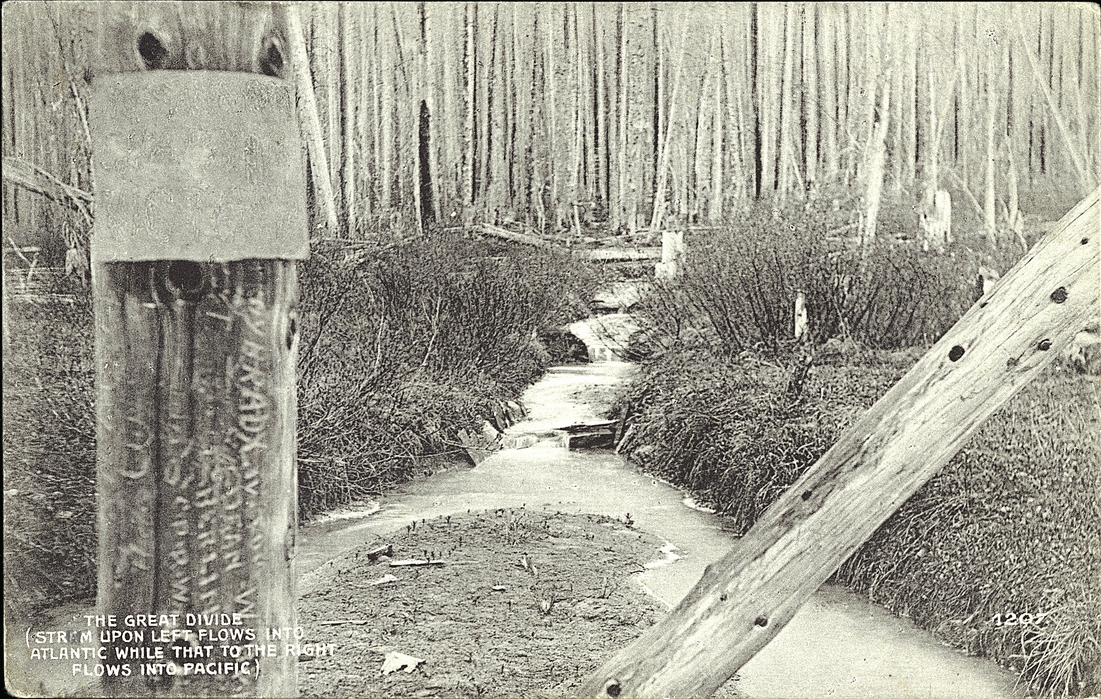
Several months ago I was in the archives, researching ways in which “The Great Divide” narrative was presented as a form of national unification, and how such categorizations and reductions of the geophysical world were so central to the “conquering nature” narrative.

Stamped: "Mailed From The Top of the World: The Great Divide" Elevation 5332 Feet"
The narratives differed, depending on a host of factors including age, gender, culture, and season, but one of the salient features of all was the consideration in which the writer attempted to convey not just what she experienced but what the landscape also brought to her. These post cards were descriptive, intimate, modest.
Qualities that are, with few exceptions, largely missing from The Facebook Travel post. Why?
First, one must dispense with any argument to the effect that Facebook posts are not postcards. Are they written from a place? Is there a medium by which they are conveyed? Do they find a reader somewhere else? If you answered in the affirmative then regardless of the other qualities that make FB posts different, they are postcards nonetheless.
But it is in these other qualities that one may be able to locate the sources of instant gratification that range from the merely banal to the outright self-congratulation and pomp that overpower any other message. To begin, the squeezing of time and space in the electronic postcard eliminates the anticipation that comes with the wait–for both writer and audience. One can imagine that the reader is watching you write the post so why reveal your thoughts, reflections.
But she is not there and therein lies one of the problems.
There seems to be a tendency toward brevity in the FB post. Why? Theoretically (and physically) speaking, the FB post is a postcard without limit yet one rarely comes across a post more than a couple of lines–unless one is on a travel blog (more on that later). Brevity breeds discontent; short bursts can be largely self-centred and devoid of reflection. Is it because one is unconsciously aware of the boundless space that a FB post provides or is the urge to tell the world that “I’m here/You’re Not” a powerful addiction, part of the human condition? In any case, the textures, feelings and reciprocities of place are subsumed under the gaze of the writer. The FB travel post is not humanity’s greatest travel writing moment.
There are ways to write electronically without exposing such self-serving, seemingly culturally specific qualities–and several people are doing this (thank you friends!). First, as stated above, travel blogs (yes, a blog!) provide a more reflective narrative, allowing for open-ended and always changing stories that the FB post either cannot or will not allow. Second, downloading photos (and text) after the trip also allows for a time lag which runs counter to the instant gratification of the nano-second post. The post-trip travelogue also signifies a level of modesty that can be in short supply next to the instant FB post.
Finally, one may question motives in sending a post this way in the first place. It may seem slightly crass–OK I’m also a little sensitive that you’re here and I’m not but I wasn’t before you sent the 12-word post– but it doesn’t take much to write a little about what you’re experiencing and, even better, how you feel people, places, things are experiencing you. That kind of writing also has value.
Or, you could send a postcard; maybe even a little trinket from your journey as well…
Happy Travels!
Meandering…A Slightly Immodest “About Me”
“One word is worth a thousand pictures”–La Grande Sauterelle in Jacques Poulin’s Volkswagen Blues
I am a fifth-year Ph.D. student in historical geography at the University of Alberta. Reading is still my greatest passion beacuse words allow me to imagine landscapes and places (and the ‘spaces’ in between) that are so important to my work. I am writing about the height of land idea in present-day western Alberta and northeastern British Columbia. My project meanders–much like heights of land and the rivers & ranges that are so vital to the boundary making narratives that get attached to these landcapes. I provide readings into all kinds of writing that frame the height of land including fiction, verse, prose, and dialogue (for movies). Oral histories that draw upon heights of land to tell stories that are transferable to other places are particularly instructive when placed side by side with fixed cartographic depictions of the height of land (commonly known as The Great Divide) that define interprovincial and treaty boundaries. I also consider visual imagery from paintings to postcards to commemorative monuments. Finally, I also use Government of Canada Record Group (RG) files , in particular the Departments of Indian Affairs and Interior.
In the end the experience of landscape is the most rewarding ‘reading’ of all. I am a proud father of a gregarious six year old who reminds me why I am doing what I’m doing. Our family moments in these places may not happen as regularly as one may wish but when they do is when I truly appreciate what I am doing.
Little surprise here: I did NOT start my Ph.D. with the above in mind but over time it has come to define me. But then again, I have had a facination with heights of land since my first adolescent forays out of the concerete urban jungle and into the Canadian Shield of Algonquin Park, Temagami, Killarney and Quetico for those precious few July and August weeks. Heights of land were invariably psychological half-way points on gruelling portages and believe me, I came to realize almost immediately why no one else was taking the dreaded wannigan: Woe on to you if you fall on the food…
So the dissertation has me, and me it. I can see the end of this portage. The next one is just over….
“You Want To Do It Right Now? Yes, Right Here, Right Now, On The Continental Divide”
So Jack and La Grande Sauterelle do “it”–at the exact spot where the rivers go east and west.
Jacques Poulin’s Volkswagen Blues (1984, translated 1988) is the story of two people searching–for Jack, his estranged brother Theo; La Grande Sauterelle (“Big Grasshopper”) an identity that isn’t just based on her metissage ancestry. Jack and Sauterelle are travelling along the concrete arteries of North America, rarely out of sight from the rivers and trails that have also facilitated earlier encounters and forged new identities in their wake.
The “Great Divide” chapter (XXIV) is a profound moment of many, a meditation on historical memory, identity and desire. The book also creates–and fits into– another puzzle that is my dissertation. I can’t imagine how I could have written a history of “The Great Divide” idea without novels like Volkswagen Blues. The dissertation process compels one to meander outside one’s comfort zone to craft an original and appealing work that challenges orthodoxies. One does not enter into such a process without anxiety but I have realized over time that a good story needs to be told through another. And wonderful novels like Volkswagen Blues do just that.
Its all about reading. It may be argued that one has not read a book until one has REread it. I wish I had the time to confirm this cliche. I take solace, however, in realizing that both the Edmonton Public Library and the University of Alberta Library are currently holding the next chapter(s) in my own private narrative.
Nonfiction or fiction next? Does it matter?…

Hello Fellow Travellers!

In a few words, I’m here. Thanks to all who convinced me. The above late 19th century “Falls of Eternal Despair” (author unknown, d. 1895) caught my interest the moment I laid my eyes on it. The landscaped stories that weave through the geography are fascinating. Troubling.
Thanks for coming through…

 Sean Atkins Canadian Historical Geography Blog